
We’re excited to launch Product Faculty’s AI CXO Podcast: actionable AI operating system playbooks for overwhelmed executives.
In our first episode, Mani Fazeli breaks down a shift most companies are underestimating:
You’re no longer just selling to humans.
You’re also being evaluated by agents acting on their behalf and that changes how products need to be built, positioned, and experienced.
If you want your product to be chosen in this new world, it’s no longer just about great UX.
It’s about becoming the product agents understand, trust, and decide on.
But how do you actually build a product ecosystem like that?
This episode answers exactly that.
What Mani Fazeli is actually doing
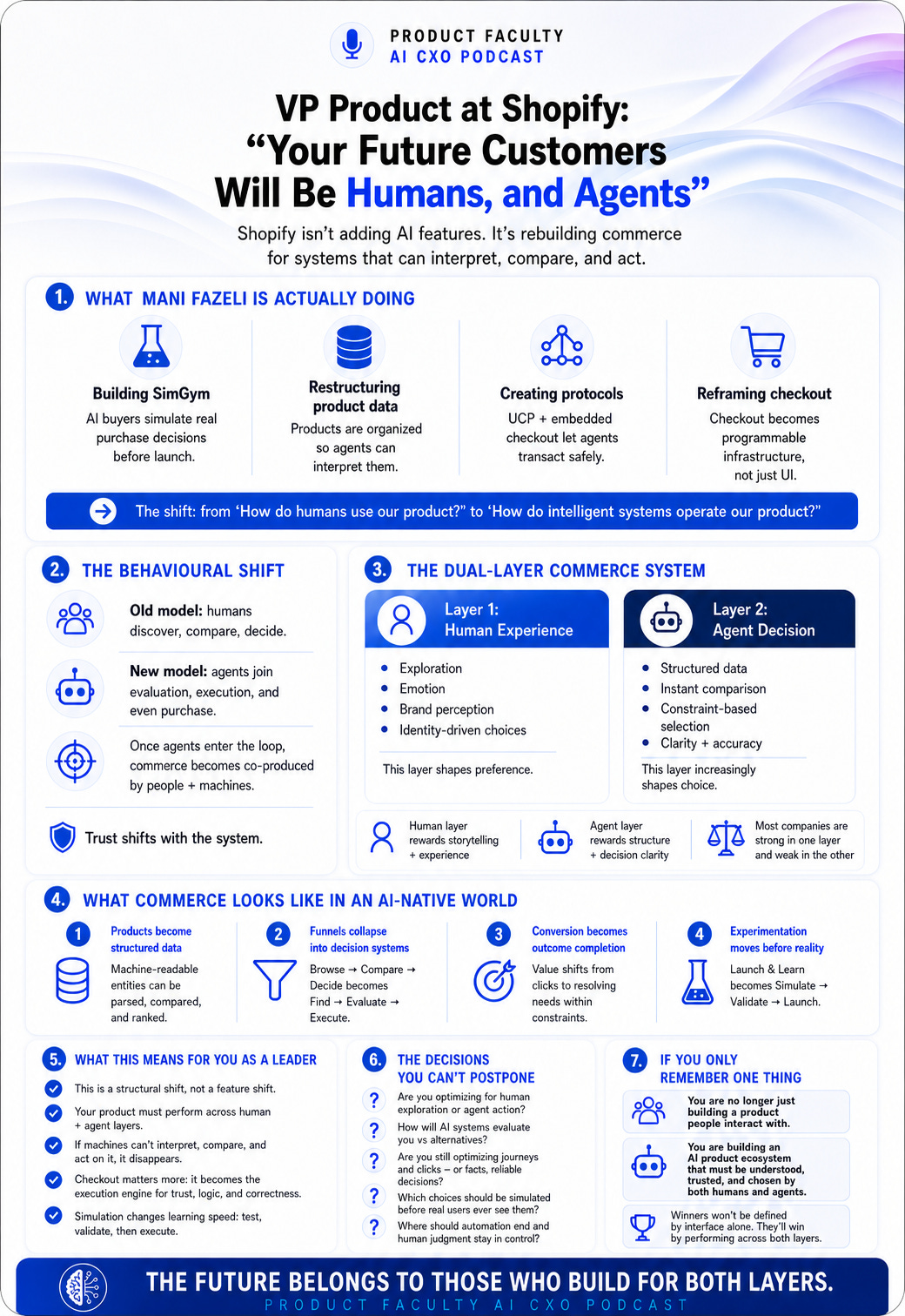
If you strip away the words and look at behavior, you’ll notice Shopify isn’t “adding AI features.” They’re rebuilding commerce as a system that agents can operate on.
A few signals most people might not know:
They’re building SimGym: AI buyers to simulate real purchasing decisions before launch
They’re restructuring product data so agents can interpret it (not just humans)
They’re creating protocols (UCP, embedded checkout) → so agents can transact without breaking merchant logic
They’re treating checkout as programmable infrastructure, not UI
It’s basically a shift from: “How do humans use our product?” to “How do intelligent systems operate our product?”
The Behavioural Shift Nobody is fully Internalizing yet
For the past two decades, commerce has been built around a predictable model.
Humans discover products, evaluate options, and make purchasing decisions through a sequence of interactions that companies have learned to optimize obsessively.
That model is quietly breaking.
We’re moving toward a world where agents don’t just assist in discovery, they actively participate in evaluation and, increasingly, execution.
In the early stages, they help refine choices. In later stages, they assemble options, pre-fill decisions, and eventually complete transactions with minimal human involvement. And we will trust them for it!
This doesn’t happen overnight, but it doesn’t need to.
Even partial delegation changes the system.
Because the moment an agent becomes part of the decision loop, commerce stops being a direct interaction between a brand and a human. It becomes a system where decisions are co-produced by machines and people.
But there’s a cleaner way to understand what’s actually happening here.
AI CXO Lens: The Dual-Layer Commerce System
What’s happening here isn’t just “AI entering commerce.” It’s a structural shift in how decisions are made. The simplest way to understand it: Every product now operates across two layers at the same time.
Not sequentially. Not optionally. Simultaneously.
Layer 1: The Human Experience Layer
This is the layer companies already understand.
Exploration
Emotion
Brand perception
Identity-driven decisions
This is where people form preferences.
Layer 2: The Agent Decision Layer
This is the layer most companies are underestimating.
Products are interpreted as structured data
Compared across alternatives instantly
Selected based on clarity, accuracy, and constraints
This is where decisions increasingly get made.
These two layers optimize for fundamentally different things.
The human layer rewards storytelling and experience
The agent layer rewards structure and decision clarity
And most companies today are over-optimized for one…
…and barely exist in the other.
What Commerce Actually Looks like in an AI-Native World
Most teams are still designing around pages, funnels, and user journeys because that’s what the internet has trained them to do.
But those constructs were built for human navigation, not machine reasoning.
1. Products become structured data
Products are no longer experienced as pages. They are interpreted as structured entities: parsed, compared, and ranked by systems that don’t browse, but reason.
Which means the constraint shifts entirely.
It’s no longer how well you present your product. It’s how clearly it can be understood, decomposed, and evaluated in a machine-readable form.
2. Funnels collapse into decision systems
The traditional flow of browsing, comparing, and deciding was built for human navigation.
Agents compress that into something far more direct: Find, Evaluate, Execute.
There is no journey in the conventional sense. The system isn’t optimizing for engagement anymore. It’s optimizing for arriving at the correct decision as quickly as possible.
3. Conversion becomes outcome completion
Conversion is no longer about guiding a user through a sequence of steps.
It becomes the ability to resolve a need within a set of constraints: price, context, preferences, with speed and accuracy.
If an agent can reach that outcome faster and more reliably than your funnel, your funnel stops being the primary interface of value.
4. Experimentation moves before reality
The old loop was simple, “Launch & Learn”
Now it shifts upstream: Simulate, Validate, & Launch.
Which fundamentally changes how risk is managed.
Weak ideas get filtered out before they ever reach users.
Strong ideas enter the real world with momentum already behind them.
What This Means For You as a Leader
If you’re leading a product organization, this is not a feature shift. It’s a structural one.
You are not adapting your product to AI. You are redesigning how your company operates around it. And more specifically, you are now responsible for performing well across both layers of the system at once.
Your product must now function in an environment where it is:
Interpreted by machines
Compared instantly
Acted upon without friction
If it cannot do those things, it doesn’t compete… it disappears.
At the same time, your brand now operates across two layers.
One is human perception, where emotion and identity matter
The other is machine interpretation, where clarity and structure decide visibility
Ignoring either side weakens you. There’s also a misconception that parts like checkout become less important.
They don’t. They become:
The execution engine
The place where business logic runs
The system that guarantees correctness
Even if the interface fades, the importance increases.
And finally, your speed of learning changes.
With simulation:
You don’t rely purely on intuition
You don’t wait for traffic
You don’t ship blindly
You test, validate, and then execute.
Over time, that compounds into advantage.
The decisions you can’t postpone anymore
At some point very soon, every leadership team will be forced to answer a set of uncomfortable questions.
Are you building a product that is easy for humans to explore, or one that an agent can accurately interpret, compare, and act on?
Do you truly understand how an AI system will evaluate your product against alternatives, and what signals determine whether you’re even considered?
Are you still optimizing around journeys and clicks, or are you redesigning your system to produce fast, reliable decisions?
Where in your development process do you replace guesswork with simulation and which decisions should never reach real users without being tested first?
And where do you draw the boundary between automation and human control, not based on capability, but on trust and experience?
If you only remember one thing
You are no longer just building a product people interact with.
You are building a AI product ecosystem that needs to be understood, trusted, and chosen… by both humans and the agents acting on their behalf.
And in that world, the winners won’t be defined by how good their interface looks.
They’ll be defined by how well they perform across both layers.
See you in the next episode.