Every single one of you might already be having this discussion within your organization: “How can we become an AI-native organization and internalize the pivot so powerfully that it becomes our competitive advantage and moat?
So wouldn’t it be helpful to hear from a leader who’s led one of the wildest pivots you’ve seen and hands you his playbook for running an AI operating system?”
I’m very excited to share that we just dropped Product Faculty’s AI CXO Podcast with Noam Lovinsky (CPO at Superhuman, formerly Grammarly).
And the person putting him in the AI-native shift spotlight is Amit Fulay (Vice President of Product, Uber) - so you already know this isn’t going to be surface-level thinking.
He’s sharing how to actually become an AI-native organization (not just use AI tools) and redesign AI workflows for speed, iteration & learning, and a lot more!
This might be the most important video you watch today.
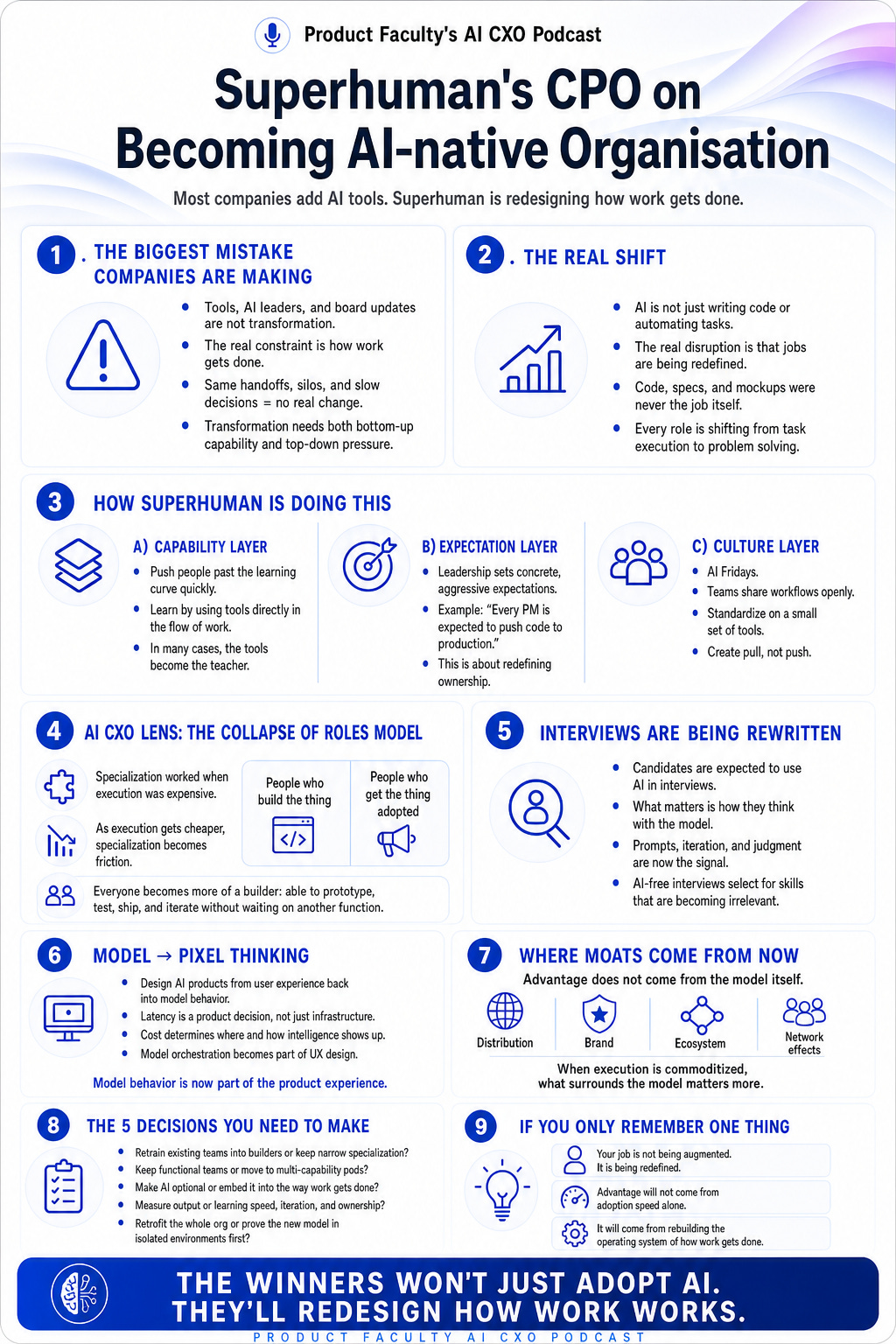
THE BIGGEST MISTAKE COMPANIES ARE MAKING
Most companies are following the same playbook.
They invest in tools.
They appoint an “AI leader.”
They report progress to the board.
It looks like transformation. It isn’t.
Because none of this touches the real constraint. Transformation is not exactly about who owns AI. It’s about how work actually gets done.
The uncomfortable truth is that you can deploy AI across your org and still operate exactly the same way.
Same handoffs. Same silos. Same slow decisions.
And that’s why nothing changes.
Real transformation doesn’t come from top-down mandates alone or sending “adopt AI by Q3 emails”
It emerges from a combination of:
Bottom-up capability (people learning and experimenting)
Top-down pressure (clear expectations and direction)
Miss either side, and the system resists change.
THE REAL SHIFT (MOST PEOPLE ARE IGNORING)
The conversation around AI is still stuck at the surface level.
People focus on:
AI writing code
AI automating tasks
AI replacing roles
But that’s not the real disruption. The real disruption is that jobs themselves are being redefined.
For years, we’ve confused the interface of work with the purpose of work.
A developer writes code. A PM writes specs. A designer creates mockups.
But those were never the jobs. They were just the tools we used.
Now that AI can perform many of those tasks, the illusion breaks.
A developer is not someone who writes code. They are someone who solves problems. Code was just one way to do that.
And this shift is not limited to engineering.
It’s coming for every role.
HOW Superhuman is Doing This
They’re evolving their systems in layers.
At the bottom, they focus on capability.
People are pushed past the learning curve quickly. They are encouraged to use tools directly, experiment, and learn in the flow of work. In many cases, the tools themselves become the teacher.
At the top, leadership sets aggressive expectations. Not vague goals like “become AI-native,” but concrete milestones that redefine what’s expected.
A powerful example: “Every PM is expected to push code to production.”
If I’ve to explain it in just 2 words, it would be “redefining ownership.”
Between those two layers sits culture.
Rituals like AI Fridays
Teams sharing workflows openly.
Standardizing on a small set of tools instead of exploring endlessly.
The goal is simple: Create pull, not push.
People adopt the new way of working because they see what’s possible… not because they’re told to.
AI CXO Lens: The Collapse of Roles Model
This is the part most organizations are not ready to accept: “Roles are collapsing.”
For decades, companies have been built around specialization.
PMs define work → Engineers build it → Designers shape it.
That model only works when execution is expensive.
When execution becomes cheap, specialization becomes friction.
What replaces it is much simpler. Not more roles. Fewer.
At the limit, organizations converge toward two archetypes:
People who build the thing
People who get the thing adopted
Everything else starts to blur & vveryone becomes a builder.
Not necessarily in the sense of writing code.
But in the sense of being able to prototype, test, ship, and iterate an idea without waiting on another function.
INTERVIEWS ARE BEING REWRITTEN
At Superhuman, Noam expects candidates to use AI during interviews and actively asks them to show their prompts.
Because the old assumption (that using AI is cheating)… no longer applies.
Using AI effectively is now part of the job itself:
What matters is not just the answer, but how the candidate thinks with the model.
How they structure prompts, iterate on responses, and apply judgment in real time becomes the real signal.
If someone avoids using AI in an interview, it’s often a sign they won’t use it effectively on the job either
This means interviews must reflect how work actually happens, not an artificial AI-free environment.
Otherwise, companies risk selecting for skills that are already becoming irrelevant.
MODEL → PIXEL THINKING (CRITICAL FOR AI PRODUCTS)
You can’t treat AI like a simple API layer anymore.
What he points out is that AI products have to be designed from the user experience backward into model behavior, not the other way around.
The interface is no longer separate from the intelligence, it is shaped by it in real time.
At Grammarly scale, where systems handle 100B+ LLM calls per week and thousands per user per day, every model decision becomes a product decision.
Latency is not just an infrastructure concern; it directly impacts how usable the experience feels.
Cost moves away from just finance; it determines how often and where intelligence can show up.
And model orchestration becomes part of UX design itself—what to call, when to call, and how to combine outputs.
This is the shift: you’re no longer building features on top of models.
You’re designing a system where model behavior is the product experience.
WHERE MOATS COME FROM NOW
If everyone has access to the same models…
And everything can be copied quickly…
Where does advantage come from?
Not from the technology itself.
From everything around it.
Distribution
Brand
Ecosystem
Network effects
These are harder to replicate.
And in a world where execution is commoditized, they matter more than ever.
The 5 decisions you need to make
If you’re serious about this shift, there are a few decisions you can’t avoid.
First, you need to decide whether you’re going to retrain your existing team into builders or continue hiring for narrow specialization. Both paths have trade-offs, but doing neither will stall you.
You need to decide how work gets structured. Do you continue with functionally separated teams, or do you move toward small, multi-capability pods that can operate independently?
How you introduce AI into your workflows. Is it an optional layer that people adopt at their own pace, or is it embedded into the expectation of how work gets done?
How you evaluate performance. Are you still measuring output and delivery, or are you measuring learning speed, iteration cycles, and end-to-end ownership?
And finally, you need to decide where to start. Do you try to retrofit your entire organization, or do you create isolated environments where the new model can prove itself before scaling?
Avoiding these decisions doesn’t slow the shift.
It just guarantees you’ll be reacting to it later.
If you only remember one thing
Your job is not being augmented.
It’s being redefined at the structural level.
And advantage won’t come from adoption speed.
It will come from rebuilding the operating system of how work gets done.